
FlexiIon - next generation heat technology.
000%01 // Flexible response
Safety First
Canal anatomy is rarely straight. FlexION brings amazing tactile awareness02 // Working control
Perfect Shaping
Coronal cutting is class leading03 // Clinical system
Simplicity
FlexION metallurgy allows for simplicity — three file systems.File Essentials
WORKING SECTION
[ 03 ] Technology architecture
FlexION decoded.
FlexION brings controlled flexibility and reliable shape recovery together for clinical shaping. Advanced NiTi metallurgy supports our focus on premium performance, single-use file systems, and exceptional value. Explore the file systems ↗
Technology basis
Advanced NiTi metallurgy
Design intent
Controlled flexibility
Clinical context
Curved canal anatomy
Product platform
TransformS file systems
Scroll to explore the science Right-click to zoom
ION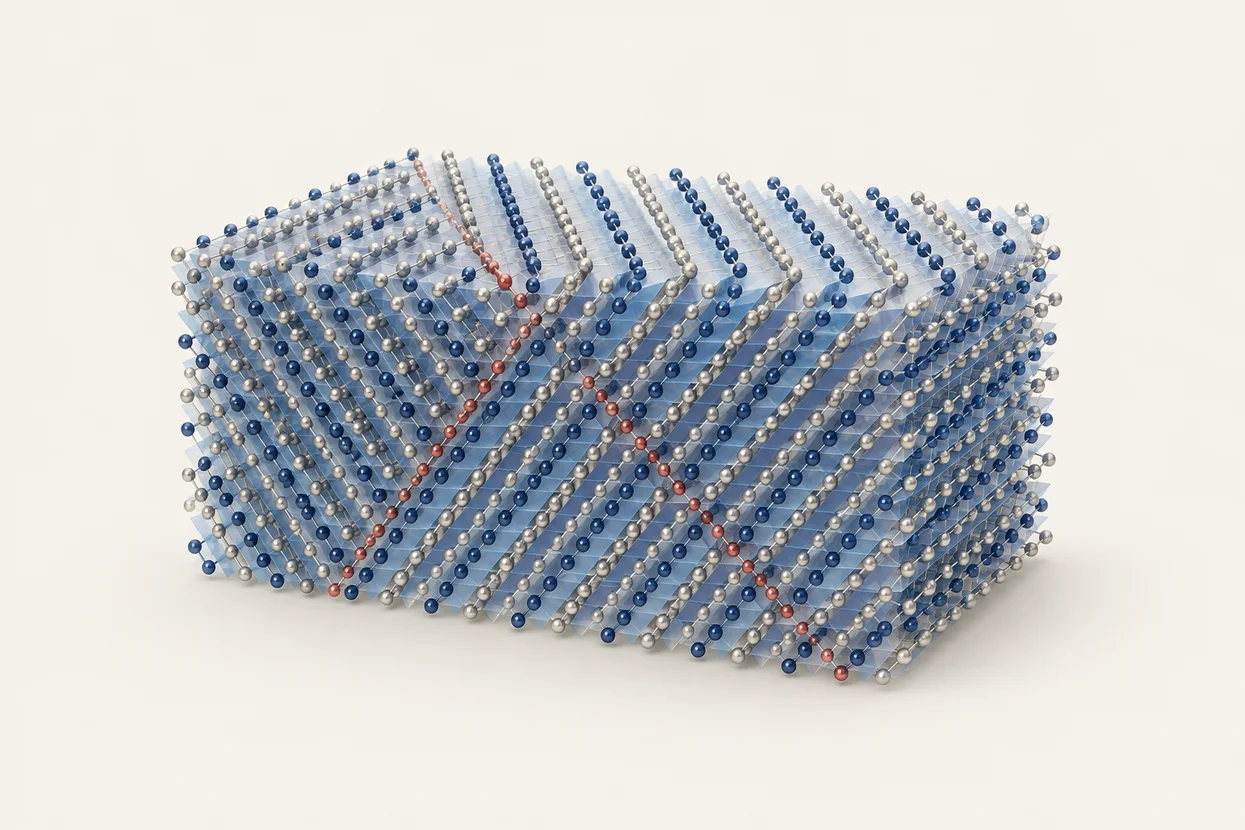
Not a measured atomic structure.
Move your mouse or scroll to rotate · Right-click to zoom
Keyboard: arrow keys to rotate · Z to zoom · Escape to zoom out
The science behind the structures. Models show atoms rearrange between cubic austenite and monoclinic martensite.
FlexION brings controlled flexibility and reliable shape recovery together for clinical shaping performance - Advancing Endodontic Safety through Advanced Metallurgy
01 / Temperature & metal
Advanced NiTi
metallurgy
A file warms up inside the tooth.
NiTi is an alloy of nickel and titanium. Its atoms can change arrangement while the metal stays solid. These different arrangements, called phases, affect how easily the file bends.
Martensite is easier to bend. Austenite is generally stiffer and tends to spring back. Heat treatment changes the temperatures at which the metal moves between phases. Some files also pass through an intermediate R-phase.
Af means austenite finish temperature: the point at which the change to austenite finishes during heating. An Af above body temperature can help retain martensite or R-phase inside the metal. Some files lose cyclic-fatigue resistance as their austenite proportion increases at body temperature. In an apical curve, breakage risk also depends on the file design, curve tightness, and technique.
Why Af is only part of the explanation
Af above 37°C does not mean a file is entirely martensitic at 37°C. The full heating and cooling history, applied stress, and file design also matter. Austenitic NiTi can still flex through stress-induced transformation. Af is not a stand-alone safety rating.
Read the research: Arias et al., 2018 ↗ · Kasuga et al., 2023 ↗
Body temperature.
The reference for testing.
02 / Bend & recovery
Controlled
flexibility
Less force to make the bend.
A flexible file needs less force to follow a curve. Its alloy, thickness, taper, and cross-section all affect that bending force. Heat treatment can reduce stiffness, but the finished file needs testing at a relevant temperature.
As a file rotates in a curve, the metal repeatedly stretches on one side and compresses on the other. Repeated loading can start a crack. This is cyclic fatigue.
Torsional overload is different: part of the file binds while the motor keeps turning. Greater flexibility or a longer fatigue life does not automatically mean greater resistance to twisting.
Download research references (PDF · 2 studies)
Bending fatigue and twisting overload are why most all files separate.
03 / The shape inside the tooth
Curved
canal anatomy
The tightness of the bend matters.
A root canal is a small passage inside the tooth. It can bend in more than one direction. A two-dimensional X-ray may hide a curve pointing toward or away from the viewer.
Two canals can turn through the same angle yet place different demands on a file. A tighter bend has a smaller radius of curvature, so the file bends more sharply over a shorter distance.
In Pruett and colleagues’ laboratory study, tighter curves and larger instruments shortened fatigue life. Files broke around the point of greatest bending. That point depends on the canal and is not always at the tip.
Shaping aims to preserve the canal’s original route while making space for cleaning. Flexibility helps, but anatomy, file selection, and technique still matter. Follow the file system’s instructions for use.
Read the research: Pruett et al., 1997 ↗ · Balani et al., 2015 ↗
Ask about our amazing Next Gen MotorLittle danger
High danger for normal files
Must visualize the 3D canal curvature — sometimes hidden in the ML plane — especially the MB canal in lower molars and the MB roots of uppers.
Explore the file systems ↗