Dentin shelf removal
Use a long-shank round bur or ultrasonic tip to remove the mesial overhanging shelf between MB1 and the isthmus.

Clinical protocol / Micro-Path™ MB2
Interactive anatomy
Finding MB2 is only the beginning. Beyond the pulp chamber, the canal may curve abruptly. A hand file can enter, then stop, but resistance does not always mean the canal is blocked.
A stiff stainless-steel file may press into the dentine instead of following the curve. Forcing it risks creating a ledge that makes further negotiation difficult. Moving from size ten to size fifteen increases tip diameter by fifty percent and reduces flexibility.
Use small, appropriately pre-curved hand files for exploration. Respect the length they can negotiate without force, and reassess if progress stops.
The seventeen-millimetre MicroPath MB2 file is designed for this first danger point. Its nickel-titanium Flex-Ion construction provides flexibility for abrupt curves within the first three to five millimetres. Its short format creates handpiece headroom, while the size fifteen tip and point-zero-five taper provide an initial preparation step. The aim is controlled entry along the anatomy without creating a ledge.
Passing the first bend does not mean the canal is straight. Deeper in the root, it may change direction again where the mesio-buccal one and mesio-buccal two canals meet. A hand file may pass the first curve but meet resistance here. Continued pressure can create a second ledge, sometimes obscured on a bite-wing radiograph.
MicroPath size thirteen and fifteen glide-path files are designed for this deeper pathway. Both have a point-zero-three taper. Size thirteen provides an intermediate step between ten and fifteen; size fifteen develops the glide path further when anatomy permits. Their smaller taper limits the increase in diameter along the working portion.
This creates a controlled transition to a reproducible glide path before larger shaping files are introduced. These files support careful exploration; they do not replace it. Let anatomy and tactile feedback guide each step.
At a deeper curve, a rotating instrument undergoes repeated tension and compression. Cyclic fatigue may cause separation, leaving a fragment toward the apex. Binding can also create torsional overload.
MicroPath establishes the glide path before larger shaping files encounter this anatomy. The short MB2 file manages initial access, followed by a size thirteen or fifteen glide-path file as appropriate. Each instrument has a defined role, rather than forcing one file through every stage. FlexION technology is designed to add safety in this demanding zone.
A University of Pennsylvania study by Iqbal, Kohli and Kim recorded eighty-one separated instruments in four thousand eight hundred and sixty-five endodontic cases. Almost eighty-three percent occurred in the apical third.
MicroPath supports a safer sequence: establish entry, develop a confirmed glide path, then shape while respecting the curvature.
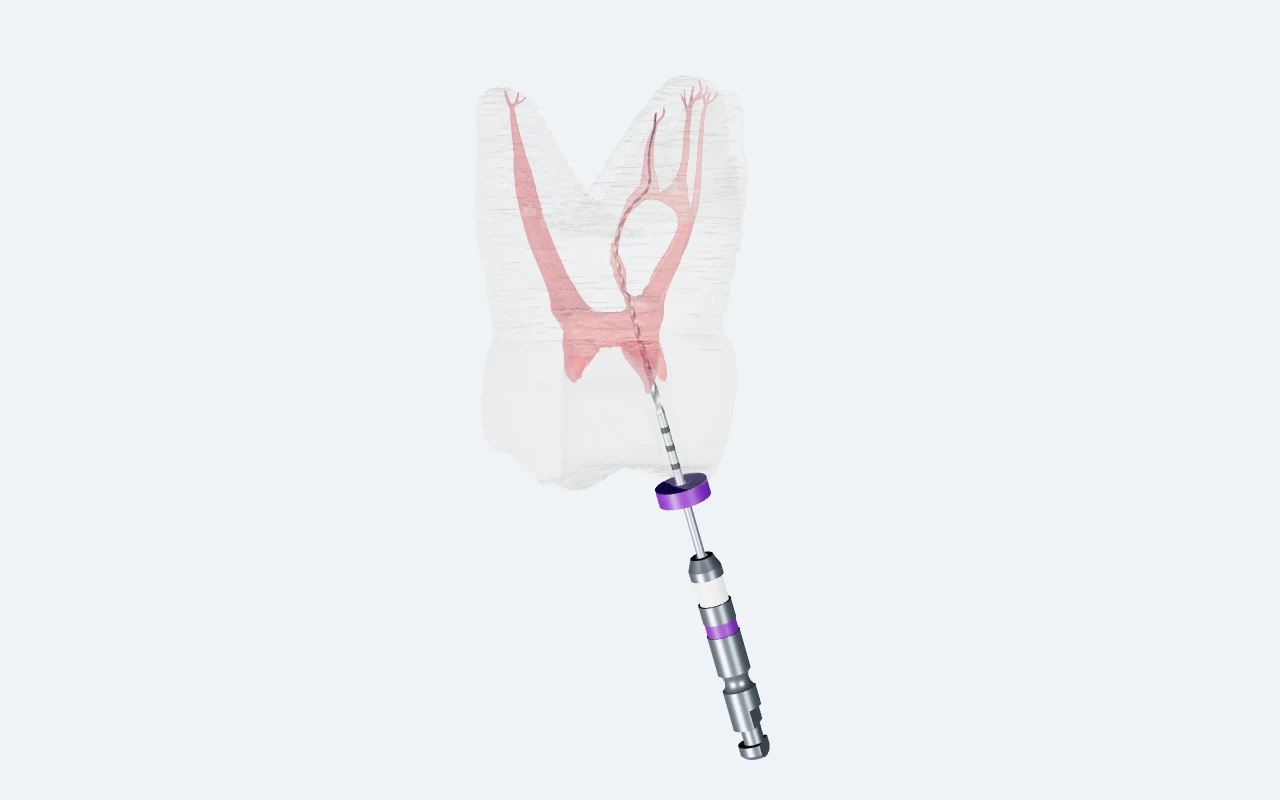
Rotate · zoom · isolate canals · inspect apical branches
MB2 glide path: the thicker rotating file follows the approved route to its apical endpoint, with the single 21 mm CAD stopper seated at the top cusp reference. Non-to-scale educational animation; wall contact/overlap is permitted, not simulated as cutting or a clinical file-fit measurement.
Watch video insteadUse a long-shank round bur or ultrasonic tip to remove the mesial overhanging shelf between MB1 and the isthmus.
Locate the MB2 orifice, commonly 1.5 mm to 2 mm palatal to the MB1 orifice along the developmental groove.
Introduce the Micro-Path™ MB2 file using feedback to confirm forward direction - never force. Use 'Available' length and then re inspect with a pre-curved hand file.
Advance 1-2 mm at a time, withdraw to clean flutes, irrigate, and do not force past resistance.
Micro-Path™ MB2 file
This is the Micro-Path™ MB2 file used in the sequence above: a short access glide-path option for controlled MB2 negotiation after the hand file has confirmed direction.
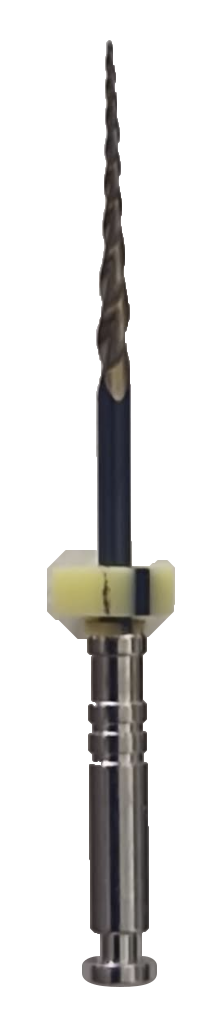
Coronal access / orifice modification
Its size 17 tip is smaller than traditional size 20 tips, giving far easier access to calcified orifices than traditional orifice openers with tip sizes of 20 or greater.
Its role is coronal orifice modification. Mini Magic supports the separate short-access MB2 step after hand-file exploration has confirmed direction.
Clinical Problem
MB2 cases often become difficult before the file reaches the canal. The access angle, headroom, visibility, and tactile feedback determine whether the clinician can enter the secondary canal without forcing the instrument off-axis.
The handpiece has less freedom to align with the MB2 entrance.
The 17 mm option can improve clearance during the access stage.
The file can engage the canal wall before the path is confirmed.
A controlled glide path step separates entry from shaping.
Small changes in tactile feedback become clinically significant.
Progression is based on repeatable entry, not pressure.
MB2 anatomy may hide under shelf dentin and isthmus detail.
The file is used to confirm a reproducible path before Transform S shaping.
Transform S Solution
The Micro-Path™ MB2 option supports a deliberate glide path step before the clinician transitions into Transform S™ ET or Transform S™ PT shaping. The objective is not simply to use a smaller file. The objective is to establish a controlled, reproducible path.
Supports improved handpiece clearance when chamber anatomy limits positioning.
Provides a deliberate access step before larger shaping files are introduced.
Keeps MB2 access inside the wider EndoTech glide path and Transform S workflow.
Clinical Benefits
15-point protocol checklist
Work from diagnosis to orientation, then controlled dentine removal, passive negotiation, pathway confirmation, and referral judgment.
